
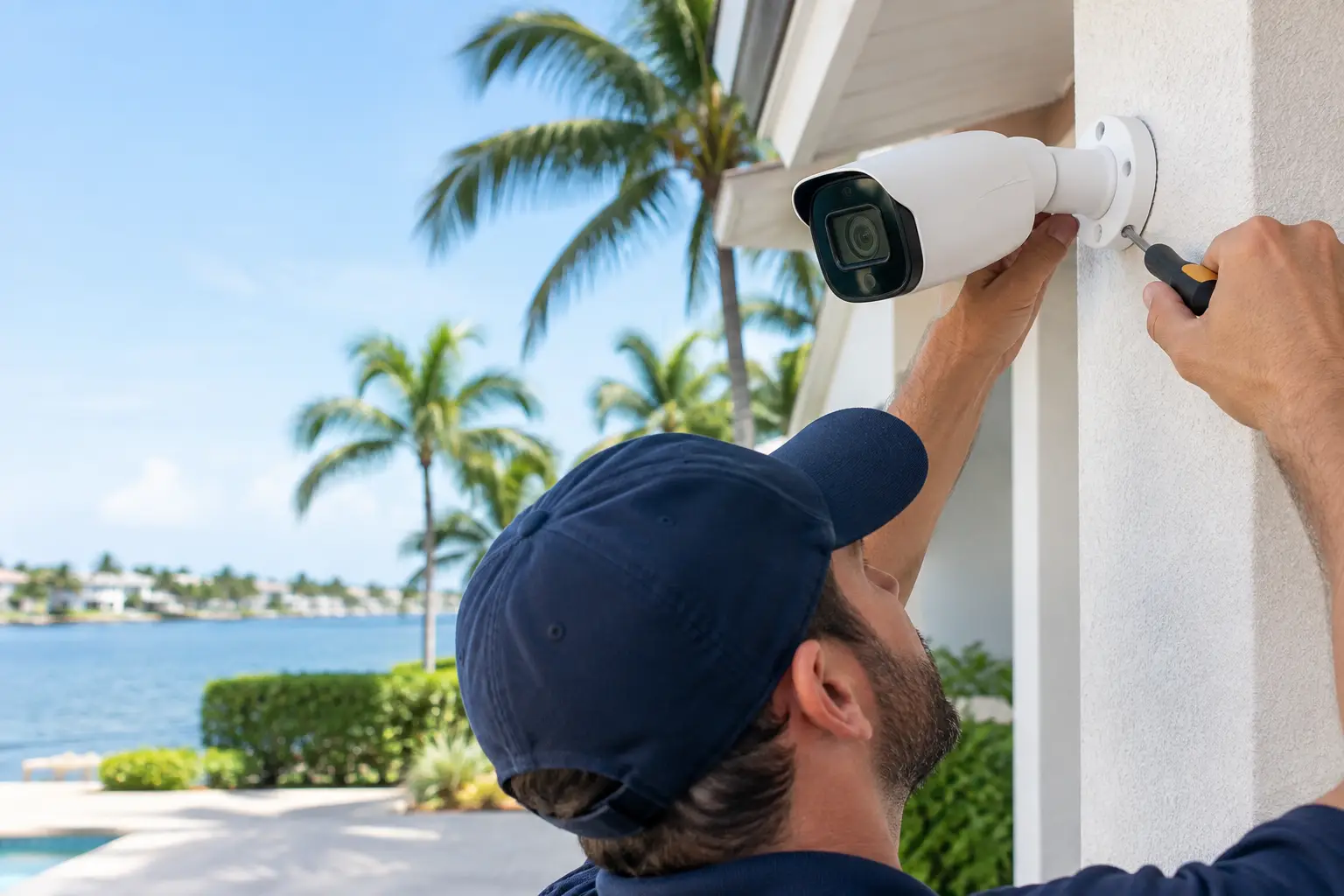
When it comes to security camera installation Palm Beach County homeowners and businesses have an important question to answer before choosing cameras: Where should the cameras actually go?
A high-resolution security camera is only useful if it is positioned where it can capture the information you need. The wrong angle, excessive height, glare from the Florida sun, landscaping, or an overlooked entrance can create blind spots that aren’t obvious until you actually need the footage.
Whether you’re protecting a home in Royal Palm Beach, a business in Wellington, or a larger property anywhere in Palm Beach County, thoughtful camera placement should be the foundation of your surveillance system.
At Certified Security Systems, we believe security camera installation starts with the property—not with a box of cameras. Before deciding what equipment to install, it’s important to understand the property’s entrances, vulnerable areas, lighting conditions, viewing distances, and potential blind spots.
💡 CSS Pro Tip
More cameras don’t automatically mean better security. A properly designed system focuses on strategic coverage. The goal is to place cameras where they can provide useful video and reduce important blind spots.
Why Security Camera Placement Matters
It’s easy to assume that installing a camera on the corner of a house or above a front door automatically means the area is protected. In reality, camera placement involves much more than simply pointing a lens toward an area.
A camera needs to capture the right field of view, at the right angle, from the right distance. It also needs to work under changing lighting conditions and remain useful at night.
For example, a camera mounted directly above a front door may capture someone standing at the door, but it may not capture a person approaching the house from the driveway. A camera mounted too high may show the top of someone’s head instead of providing useful facial detail.
Professional security camera installation in Palm Beach County should therefore begin with a walkthrough of the property and an assessment of how people and vehicles move around it.
Top 5 Security Camera Placement Tips
1. Start With Your Entry Points
The first areas to consider when planning security camera coverage are the places where people can enter or approach your property.
For a typical home, this may include:
- Front doors
- Back doors
- Side doors
- Garage doors
- Driveways
- Side gates
- Pool access areas
- Accessible windows
- Other exterior access points
Don’t focus only on the door itself. Think about the path someone would take to reach the door.
For example, a front-facing camera may show your front porch perfectly while missing someone approaching from the side of the property. Adding another camera or changing the viewing angle may provide much more useful coverage.
Reolink’s guidance on where to place home security cameras also emphasizes entry points, driveways, garages, yards, and other important areas when planning a surveillance system.
2. Don’t Forget Side Yards, Gates, and Backyard Access
One of the easiest areas to overlook is the side of the property.
Homeowners naturally think about the front door and driveway, but side yards and gates can provide another route to the backyard. Depending on the layout of the property, someone may be able to move from the street to the backyard without ever entering the field of view of a front-facing camera.
When planning security camera installation Palm Beach County properties, side gates and narrow side yards deserve particular attention.
This can be especially important on larger South Florida properties where the home, driveway, fence line, pool, detached structures, and landscaping may create multiple separate areas to monitor.
🏡 From Our Experience
Side gates are frequently overlooked during DIY camera installations. If a gate provides access to the backyard, it should be considered when planning the overall surveillance layout.
3. Choose the Right Camera Height and Angle
Camera height can make a significant difference in the usefulness of recorded video.
It may seem logical to install an outdoor camera as high as possible to keep it out of reach. However, mounting a camera too high can change the viewing angle and make it harder to capture useful facial or identifying details.
The correct height depends on the camera, lens, property, mounting surface, and the area being monitored.
When determining placement, consider:
- How far the camera is from the area being monitored
- Whether faces will be visible from the camera angle
- Whether vehicles or license plates need to be captured
- How much of the image is occupied by walls, roofs, or pavement
- Whether the camera can be reached easily
- Whether landscaping could eventually obstruct the view
A camera shouldn’t simply provide a picture of an area. It should provide useful video of that area.
4. Consider Sunlight, Glare, and Nighttime Lighting
Florida sunshine is great for people who love South Florida.
Security cameras? They’re a little more complicated.
A camera pointed directly toward intense sunlight can experience glare, washed-out portions of the image, and reduced visibility. Bright outdoor lights can create similar problems at night.
That’s why camera placement should be evaluated at different times of day whenever possible.
A camera location that looks perfect at 10:00 a.m. may look very different when the afternoon sun moves across the property. The same camera may also have a completely different view after sunset.
Professional security camera installation in Palm Beach County should take changing lighting conditions into account.
🌴 CSS Florida Security Tip
Don’t evaluate an outdoor camera location only during daylight. Consider how the camera will perform during bright afternoon sunlight, sunset, nighttime, and periods of heavy rain.
5. Design for Useful Coverage, Not Just a Live View
Here’s one of the most important things to remember when planning a surveillance system:
A camera can show you what’s happening without necessarily showing you what you need to know.
When deciding where to install cameras, think about the information you would want if something actually happened.
Would you want to see:
- A person’s face?
- A vehicle approaching your property?
- A license plate?
- Someone entering through a gate?
- Activity around a pool or backyard?
- Movement along a fence line?
- People approaching a commercial building?
- Vehicles entering or leaving a parking area?
The answer can affect the camera type, lens, resolution, mounting height, and viewing angle you need.
For example, a wide-angle camera may be excellent for monitoring a general area, while a camera with a narrower field of view may be more appropriate when you need greater detail at a longer distance.
For larger properties, overlapping views can also help reduce blind spots. Fixed cameras may provide detailed coverage of specific areas while PTZ cameras can provide flexible monitoring of larger spaces.
Our Security Resources & Education Center also includes a CCTV Camera Placement Planner to help homeowners think through potential camera locations before installation.
Common Security Camera Placement Mistakes
Even an excellent camera system can underperform when the cameras aren’t positioned correctly.
Here are some common mistakes to avoid:
| Placement Mistake | Why It Matters |
|---|---|
| Mounting cameras too high | The angle may make facial details harder to capture. |
| Ignoring side entrances | Hidden access points can remain outside the camera’s view. |
| Pointing directly toward bright sunlight | Glare can reduce useful image detail. |
| Ignoring landscaping | Trees, shrubs, and palms can eventually obstruct the camera. |
| Covering only the front door | Other approaches to the property may remain uncovered. |
| Using the wrong lens for the distance | A wide view isn’t always ideal for identifying distant subjects. |
What Does Security Camera Installation Palm Beach County Include?
Professional security camera installation Palm Beach County projects can involve much more than mounting cameras to a wall.
A properly planned installation may include evaluating the property, identifying important entry points and blind spots, selecting appropriate camera types and lenses, determining mounting locations, planning cable routes, installing network equipment, configuring recording equipment, and testing the system.
The exact installation depends on the property and the type of surveillance coverage needed.
For example, a small residential property may require a straightforward camera layout, while a large home or commercial property may need multiple camera types, longer cable runs, additional storage, specialized lenses, PTZ cameras, or license plate recognition.
Indoor Security Camera Placement
Outdoor cameras usually receive the most attention, but indoor camera placement also deserves careful consideration.
Rather than installing cameras in every room, consider the areas where people naturally move through the property.
Depending on the home or business, that may include:
- Main entryways
- Hallways
- Staircases
- Common areas
- Garage entrances
- Storage areas
- Other important access routes
Privacy should also be considered. Bedrooms, bathrooms, and other areas where people have a reasonable expectation of privacy generally should not be monitored by security cameras.
The goal is to monitor important access points and activity without unnecessarily recording private spaces.
PoE vs. Wi-Fi Security Cameras
The location of your cameras can also influence whether a PoE or Wi-Fi system makes sense.
Power over Ethernet, or PoE, cameras use network cabling to provide both power and data to the camera. This makes PoE a popular option for professionally installed surveillance systems where reliable connectivity and continuous recording are important.
Wi-Fi cameras can provide flexibility in locations where running network cable is difficult, but they still depend on a reliable wireless connection and an appropriate power source.
Neither option is automatically right for every property. The building layout, wiring possibilities, camera locations, network environment, and surveillance goals should all be considered.
Learn more about our security camera installation services and the types of surveillance systems we install throughout Palm Beach County.
Security Camera Installation in South Florida: Don’t Forget the Environment
Outdoor surveillance equipment in South Florida has to deal with a unique environment.
Heat, humidity, heavy rain, tropical weather, strong sunlight, and rapidly growing landscaping can all affect an outdoor camera installation.
Outdoor cameras should be appropriate for the environment in which they will be installed. Mounting hardware, cable routing, connections, and equipment locations should also be planned with long-term reliability in mind.
Landscaping deserves special attention. A camera may have a clear view when it is installed, but palms, shrubs, vines, and other plants can grow into the camera’s field of view over time.
That is another reason camera placement should be evaluated as part of the entire property rather than simply choosing the highest or easiest mounting location.
🌴 CSS Pro Tip
When planning an outdoor camera system, look at the property as it will be—not just as it is today. Consider trees, palms, shrubs, future landscaping, lighting changes, and anything else that could eventually interfere with the camera’s view.
How Many Security Cameras Do You Need?
There isn’t a universal number of cameras that works for every Palm Beach County property.
A small home with a compact layout may require a very different system than a large Wellington property, a commercial building, a warehouse, or a property with multiple gates and detached structures.
That’s why we recommend starting with the property instead of starting with a camera package.
First identify the areas you want to monitor. Then consider the viewing distance, lighting, field of view, desired image detail, recording requirements, and potential blind spots.
Only after those questions are answered does it make sense to determine how many cameras are actually needed.
You can use our CCTV Camera Placement Planner to start thinking through your coverage before installation.
🚨 CSS Myth
Myth: “If I can see my driveway on the camera, my driveway is covered.”
Not necessarily. A camera may show the driveway while still being too far away, aimed at the wrong angle, affected by glare, or unable to capture the detail you need. Security coverage isn’t just about seeing an area—it is about getting useful video from that area.
Security Camera Installation Palm Beach County: Designing the System Around Your Property
There is no single camera layout that works for every property.
A home in Royal Palm Beach may have completely different surveillance requirements than a business in West Palm Beach. A property in Wellington may have long driveways, gates, detached garages, pool areas, or large yards that require a different approach.
That is why professional system design starts by evaluating the property and identifying the areas that matter most.
At Certified Security Systems, we consider entry points, blind spots, lighting, camera views, wiring, recording requirements, and the goals of the homeowner or business when planning a surveillance system.
Our installations can include PoE cameras, Wi-Fi cameras, AI-powered detection, NVR recording, remote viewing, PTZ cameras, license plate recognition, and other surveillance technologies depending on the property and the objectives of the system.
You can see examples of completed projects on our Security Camera Installation Portfolio.
Final Thoughts: Start With Camera Placement
The best security camera system isn’t necessarily the system with the most cameras or the highest resolution.
It’s the system that is designed around the property and installed where the cameras can actually do their jobs.
Before purchasing a security camera, walk around your property and look for the places someone could approach, enter, hide, or move through without being seen.
Then ask yourself:
- Where are my most important entry points?
- Where are my blind spots?
- Can the camera capture useful detail?
- Will sunlight or nighttime lighting affect the image?
- Could landscaping eventually block the view?
- Do I need a different camera or lens for this location?
- Would overlapping coverage improve the system?
- How long do I need recorded footage to be stored?
If you’re still unsure, professional system design can help you determine what equipment and placement make sense for your property.
Certified Security Systems provides professional security camera installation throughout Palm Beach County, including Royal Palm Beach, Wellington, West Palm Beach, Westlake, Loxahatchee, Lake Worth Beach, Palm Beach Gardens, Jupiter, Boca Raton, Boynton Beach, Delray Beach, Greenacres, and surrounding communities.
📞 Call 561-285-2780 or visit our security camera installation service page to learn more.
Frequently Asked Questions
Where should I install security cameras around my home?
Start with important entry points such as the front door, back door, side entrances, garage, driveway, gates, and other areas that provide access to the property. Camera placement should also account for blind spots, lighting, viewing distance, and the camera’s field of view.
How high should a security camera be mounted?
The ideal height depends on the property and camera, but outdoor cameras are generally positioned high enough to discourage easy tampering while still maintaining a useful viewing angle. Mounting a camera too high can make identification more difficult.
Should security cameras cover the driveway?
For many homes, yes. Driveways can be important areas to monitor because they provide access to the property and may contain vehicles or other valuables. The camera should be positioned to capture the approach and the level of detail needed for the intended purpose.
Are PoE security cameras better than Wi-Fi cameras?
Both can be useful depending on the installation. PoE cameras use network cabling for power and data and are commonly used in professionally installed surveillance systems. Wi-Fi cameras can provide flexibility where running cable is difficult. The property and installation requirements should determine which solution is appropriate.
How many security cameras do I need?
It depends on the property’s size, layout, entry points, blind spots, camera field of view, and the level of detail you want to capture. A professional camera layout can help determine how many cameras are actually necessary.
Can I plan my security camera placement before installation?
Yes. Certified Security Systems offers a CCTV Camera Placement Planner that can help homeowners visualize potential camera locations before installation.
Helpful Security Camera Resources
- Security Camera Installation in Palm Beach County
- Security Resources & Education Center
- Security Camera Installation Portfolio
- Which Type of Security Camera Should You Choose?