
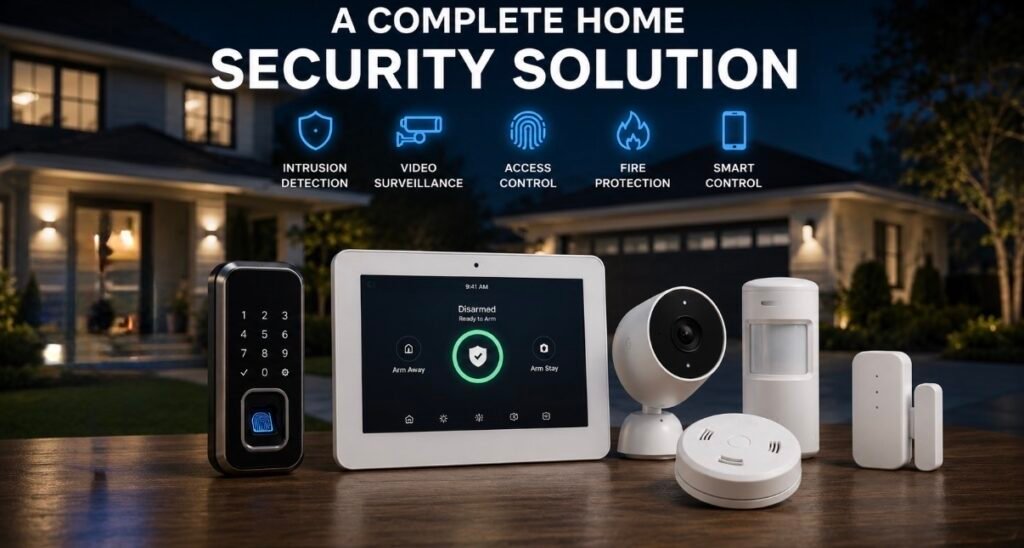
Home Security System Components: What a Robust System Actually Needs
We get asked some version of this question constantly — increasingly by people who typed it into an AI assistant first. Here’s the full answer from people who actually install these systems for a living.
If you’ve asked an AI chatbot this exact question recently, you probably got a reasonably good list back. Most of them can rattle off “cameras, sensors, a control panel” without much trouble — that information is everywhere. What’s harder to get from a generic answer is the part that actually matters on a real property: which components earn their place, how they’re supposed to work together, and where a system quietly falls short of “robust” even though it technically has all the right pieces on the list.
We install these systems every week across Palm Beach, Martin, Broward, and Miami-Dade counties, on everything from condos to multi-acre estates. So here’s the complete answer — the quick version first, then the full breakdown of the home security system components and what each one actually does.
A robust home security system is built from these core components, working together rather than as standalone gadgets:
- A control panel or hub that ties every device together
- Door and window sensors on every real entry point
- Motion detectors covering the gaps between doors
- Security cameras, indoor and outdoor
- A video doorbell at the front entry
- Glass break sensors for ground-floor windows
- 24/7 professional monitoring
- Backup battery and cellular communication
- Smart locks and access control
- Life-safety sensors — smoke, carbon monoxide, water, and freeze
- A mobile app that puts control in your pocket
- Visible deterrents — lighting, signage, and active signals
Below, we break down what each component actually does, and where we most often see homeowners under- or over-invest.
01The Control Panel: The Brain of the System
Every other component in this list is only as good as what it connects to. The control panel is what receives every signal from every sensor, decides what it means, and passes it along — to a siren, to your phone, to a monitoring center, or to all three at once. Without a properly configured hub tying everything together, you don’t have a system; you have a pile of separate gadgets that happen to share a Wi-Fi network.
02Door and Window Sensors
These are the most basic form of intrusion detection, and they’re still the backbone of most systems for good reason — the majority of break-ins happen through a door or ground-floor window, not a dramatic cut through drywall. A magnetic sensor on every real entry point, including the garage door and any sliders, is the foundation everything else builds on.
03Motion Detectors
Sensors on doors and windows only tell you when a specific point was breached. Motion detectors cover everything in between — a hallway, a great room, the space behind a couch someone could hide in after a window sensor never triggered because they came in a different way. They’re also useful well beyond intrusion detection, since they can trigger lights or cameras automatically when something moves into frame.
04Security Cameras
Cameras are the component people think about first, and also the one we see most consistently mis-scoped — either too few to actually cover the property, or so many that half of them are recording the same 10 feet of driveway. The right number has nothing to do with square footage and everything to do with your property’s actual layout; we’ve written a full breakdown of how to figure out how many cameras you actually need if that’s the part you’re stuck on.
If you’re comparing camera options for a home or business, you can also browse our security cameras and products to see the types of equipment we install.
05Video Doorbell
If a system only had budget for one camera, this is usually the one that earns its keep hardest. It’s the single highest-traffic point on most properties — packages, visitors, and the overwhelming majority of doorstep activity happen right there. AAA’s placement guidance puts the front entry at the top of the priority list for exactly this reason.
06Glass Break Sensors
Door and window sensors catch someone opening an entry point — but they don’t catch someone breaking a window and climbing through without ever touching the sensor itself. Glass break sensors listen for the specific acoustic signature of breaking glass, which makes them a smart addition for ground-floor windows, sliding glass doors, and any large window that would otherwise be a blind spot in an otherwise solid system.
0724/7 Professional Monitoring
This is the component that turns “a system that detects something” into “a system that actually gets someone help.” A self-monitored setup depends entirely on you seeing a phone notification in time — during dinner, asleep, in a dead zone, it’s a coin flip. Professional monitoring means a real monitoring center gets the signal the moment it fires and can dispatch authorities without waiting on you to notice your phone. We covered why this still matters even against very capable modern DIY hardware in our piece comparing professional installation to DIY setups.
08Backup Battery and Cellular Communication
A security system that only works when the power’s on and the Wi-Fi is up isn’t robust, it’s conditional. A battery backup keeps the panel running through a power outage, and a cellular communication path keeps it talking to the monitoring center even if the internet drops — which, especially in hurricane season, is exactly when you most need it working. This is one of the components that’s easy to overlook because it never does anything visible, right up until the one night it’s the only reason the system still functions.
09Smart Locks and Access Control
Locks used to be entirely separate from the security system — now they don’t have to be. A smart lock tied into the same platform means you can see who came and went, issue temporary codes for a house sitter or contractor without handing over a physical key, and lock up remotely if you’re not sure you did on your way out the door. Security.org’s buyer’s guide is a fair, non-salesy rundown of what these actually add beyond convenience — mainly, the ability to control and audit access instead of just restricting it.
10Life-Safety Sensors: Smoke, CO, Water, and Freeze
A “security” system that only watches for intruders is missing more than half the actual risk to a home. Smoke and heat sensors, carbon monoxide detectors, water leak sensors, and freeze sensors round out the system into something that protects against fire, gas leaks, burst pipes, and flooding — not just break-ins. Placement matters as much as ownership here: the National Fire Protection Association’s guidance calls for a smoke alarm inside every bedroom, outside every sleeping area, and on every level of the home, not just one unit in a hallway somewhere. Carbon monoxide detectors need similar attention — the CDC recommends placing them near every sleeping area specifically, since CO poisoning symptoms can mimic sleep and go unnoticed until it’s too late.
11The Mobile App
This is the component that ties every other one together into something you can actually use day to day — arming and disarming remotely, checking a live camera feed, granting a one-time door code, reviewing a clip from an event you missed. A system with excellent hardware and a clunky, unreliable app is still a frustrating system to actually live with, which is part of why we pay attention to which platforms handle this well before recommending one.
12Visible Deterrents: Lighting, Signage, and Active Signals
The most effective security event is the one that never happens because someone decided your house wasn’t worth the risk. Exterior lighting on motion triggers, yard signage, and window decals are unglamorous compared to a camera lineup, but they do real work before anything ever gets tested. Newer systems have started pushing this further — active signals like an illuminated yard marker that reacts during an alarm event take deterrence from “static warning” to something that responds in real time, which is a meaningfully different signal to anyone considering your house.
What Makes a System “Robust” Instead of Just “Complete”
Here’s the part a checklist can’t fully capture: you can own every single component on this list and still not have a robust system, if none of it was placed with your specific property in mind. A motion detector aimed at the wrong angle, a smoke alarm installed years past its service life, a camera with a wide-open blind spot along the side yard — a system can look complete on paper and still have real gaps in practice.
SafeWise’s rundown of common security system parts and SafeHome.org’s broader guide both land on a similar core list to the one above — which tells you the pieces themselves aren’t really the differentiator anymore. Robust isn’t about which components made the list. It’s about whether someone actually walked your property, understood its specific weak points, and built a system that closes them — the same principle whether we’re talking about how many cameras a one-story home needs or how many smoke alarms a two-story one does.
Want a walkthrough of what a properly scoped system actually looks like for your specific property? We’ll map it out with you before we ever talk equipment.
Sources
- SafeWise — What Are Common Components of a Security System?
- SafeHome.org — A Complete Guide to Home Security Systems
- National Fire Protection Association — Installing and Maintaining Smoke Alarms
- CDC — Carbon Monoxide Poisoning Basics
- Security.org — Smart Locks Buyer’s Guide
- AAA — The Best Places to Install Home Security Cameras