
3:07 a.m. The siren is screaming. Nothing happened.
Here is how to stop Palm Beach County false alarms and make your alarm rare, believable and fine-free.
It’s 3:07 a.m., your alarm is screaming, your dog is hiding, and a deputy may be on the way to a house where nothing happened. In Palm Beach County, that false alarm can cost you a fine, and it teaches your family to ignore the one sound that is supposed to matter.
After 20 years as an educator, I believe in one thing above all: people make better decisions when they understand how things work. So here is how false alarms happen, what Palm Beach County requires from alarm owners, why switching companies is easier than you think, and how today’s AI cameras are finally ending the “motion detected” spam.
Most false alarms are not break-ins. They are fixable.
of intrusion alarms in Tampa turned out to be false, according to a city audit. That meant about 19,000 officer responses over three years.
Tampa is not Palm Beach County, but the lesson travels: the problem is rarely a criminal. It is almost always something ordinary. The usual suspects we see in South Florida homes:
- Low backup batteriesSensor batteries typically need replacing two or three years in, and the 3 a.m. chirp is just a battery asking for attention, not a ghost.
- User errorA guest, a cleaner or a teenager opens a door and cannot remember the code.
- Pets and moving airA motion sensor aimed at a staircase, a ceiling fan or a jumping dog.
- Loose or misaligned sensorsHumidity and settling shift magnets over the years, and so does any contractor working nearby. New windows, paint and doors are the classic way a sensor gets knocked loose.
- Aging equipmentPanels from the 2000s that still depend on a landline are an upgrade waiting to happen. Here are five signs yours is outdated.
A homeowner had new windows installed, and the window installer took down the sensor on his door. The homeowner tried to put it back himself and mounted it upside down. His panel warned him something was wrong, he ignored the warning, and he armed the system anyway. Then the sensor fell off the door and tripped a false alarm.
Nobody did anything unreasonable, and the whole thing was preventable. The lesson is simple: if anyone touches your sensors, have them checked, and never arm your system through a warning on the panel. The panel is trying to teach you something.
Every one of these can be fixed with a service visit, a setting change or a new sensor. The real cost is bigger than the fine. Each false alarm trains your household, your neighbors and even responders to treat the siren as noise. We want your alarm to be rare, and believable, when it speaks.
The Palm Beach County permit most people forget
If you operate a burglar alarm in Palm Beach County, the Sheriff’s Office requires a permit. The PBSO Alarm Unit charges $25 to register and $25 a year to renew, and the fine schedule for Palm Beach County false alarms is why it pays to understand the rules:
| False alarms in a permit year | Fine |
|---|---|
| 1st and 2nd | None |
| 3rd and 4th | $50 each |
| 5th | $75 |
| 6th through 9th | $100 each |
| 10th and later | $500 each |
The consequences go beyond money. According to PBSO, unpaid fines or more than five false alarms in 365 days can suspend deputy response to your address. A permit also requires a key holder other than you, who can respond, open the premises and deactivate the system, and every system must have a backup power supply.
Two details trip people up. Only the monitoring company can cancel a false alarm call, so customers cannot call it off themselves. And the rules above come from PBSO, so confirm which agency responds to your address and whether your city adds its own requirements.
Palm Beach County alarm permit: quick answers
Do I need an alarm permit in Palm Beach County?
Yes. The Sheriff’s Office says everyone operating an alarm system in Palm Beach County must register it. Not sure which agency covers your address, or whether your city adds its own rules? Call us and we will help you sort it out.
How much does the permit cost?
It is $25 to register and $25 a year to renew. PBSO mails the renewal invoice during your renewal month each year, and you can pay online or by mail.
How many false alarms are free?
Two per permit year. Starting with the third, fines begin at $50 and climb to $500 each from the tenth false alarm on.
Does renewing my permit reset my false alarm count?
According to PBSO, paying your renewal along with any outstanding fines clears the false alarms from your premises record and resets the count to zero. That is one more reason to keep the permit current.
How CSS helps. As part of every install, we walk you through applying for your Palm Beach County alarm permit, so the paperwork never becomes your problem. If you are not sure whether your permit is current, call us at 561-285-2780 and we will help you check. You can also start at the PBSO online permit page, or see our alarm system installation services.
Switching companies without ripping out your system
Here is a myth that keeps people stuck with a system that misfires: “If I leave my alarm company, I have to start over.” In many cases you do not. A new company can often take over your existing equipment, keep the sensors and panel that still work, and replace only the parts causing trouble.
Whether your system qualifies depends on the panel and how it was installed, so a technician needs to look at it. Before you call, gather four things:
- Your contract paperwork. Know your end date and any cancellation terms before you switch monitoring.
- Who owns the equipment. Some agreements leave the hardware with the company, so ask.
- Your master code. A takeover goes faster when the panel is accessible.
- A list of your false alarm triggers. Tell the technician which door, room or time of night keeps setting it off.
This is where a company that works with any brand matters. We take over most brands, including the very popular Qolsys systems. If your sensors are a different brand, we can use a translator, a small device that lets an ADT panel read them, so you keep the sensors you already own and still end up with an ADT panel. Fixing the weak sensor is usually cheaper than starting from zero, and it is the fastest way to stop the false alarms that earn fines. Curious what an upgrade involves? Read our guide to upgrading an old alarm and camera system.
What a service call really looks like
Because we take installation seriously, we don’t get many service calls, and the ones we do get are rarely dramatic. Here is what actually fills our schedule:
Customers can reprogram the Wi-Fi on their own, but we offer to come out and do it, because it is a good excuse to check in on the whole system.
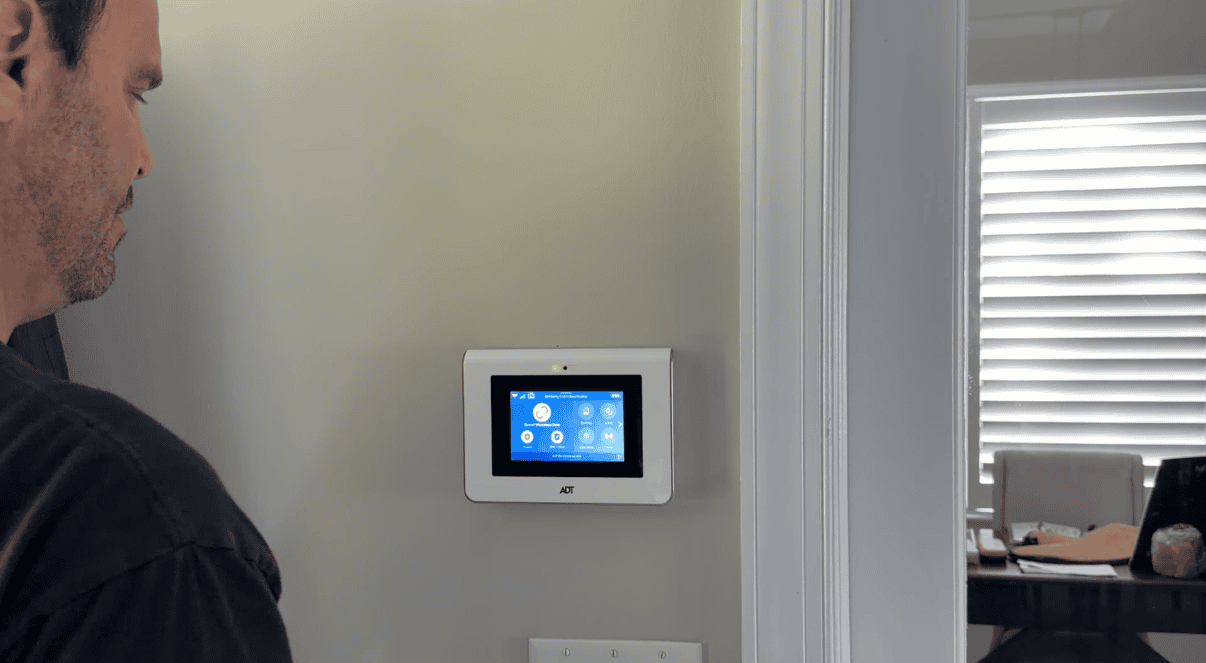
Watch the service call: a real CSS technician fixing a false alarm in Wellington, FL
My favorite service story comes from the Wellington Aero Club. A year after we installed his system, we were back at his home adding more cameras. He liked them so much that he decided to add three more at his airplane hangar, and while we were there he asked us to adjust one camera. That is what a healthy system looks like: a customer who calls because he wants more, not because something is wrong. See more of our Wellington camera work.
Cameras that finally know a person from a palm frond
By the third notification of the night, most people muted the app, which is the camera version of ignoring the siren. Google’s current Nest cameras include person, vehicle and animal alerts out of the box, plus package alerts on the doorbell, with no subscription required for those basics. Other brands now offer similar smart detection, including systems we install such as Reolink and Ubiquiti.
What that means for a Palm Beach County homeowner:
- Fewer pointless alerts. Set the camera to notify you for people only, and the sprinklers stop waking you up.
- Alerts you trust. When your phone buzzes, it matters, and you look.
- A faster answer to “was that real?” A short clip lets you check what happened before you panic or call anyone.
A woman was caring for her elderly mother, and the family cat kept romping around at night. Her phone buzzed in the middle of the night over and over, for a cat. We changed her alerts so that only a person triggers them, and set a buzzer to sound when one does. Now the alert she gets is one she needs to act on. (More on this in our guide to home security for aging parents.)
AI is not magic. Placement still decides whether a camera sees faces or hat tops, and a lens fogged by Florida humidity will confuse any software. That is why we design the camera layout first and let the smart detection do the filtering second. Questions about what AI cameras do with your footage? We covered that in AI security cameras and privacy.
Your 10-minute checklist to stop Palm Beach County false alarms
- Replace the panel and sensor backup batteries if it has been over a year or two
- Confirm your Palm Beach County alarm permit is current
- Name a key holder other than yourself and make sure your emergency numbers are up to date
- Walk the house and test every door and window sensor for loose or misaligned magnets
- After any window, door or paint work, have the sensors checked before you arm the system
- Never arm through a warning on the panel; find out what it is telling you
- If you change your Wi-Fi, update the credentials on your alarm panel or call us
- Check that motion sensors are not pointed at fans, vents or the pet’s favorite perch
- Turn on person-only alerts on your cameras
- Make sure everyone in the house knows the code and the disarm routine
Stuck? Let’s make your alarm believable again.
If you get stuck, or your system is older than your last roof, let us take a look. Our team serves Palm Beach, Martin, Broward and Miami-Dade counties and beats any written quote, always.
Call 561-285-2780Send us a message Browse our FAQs