
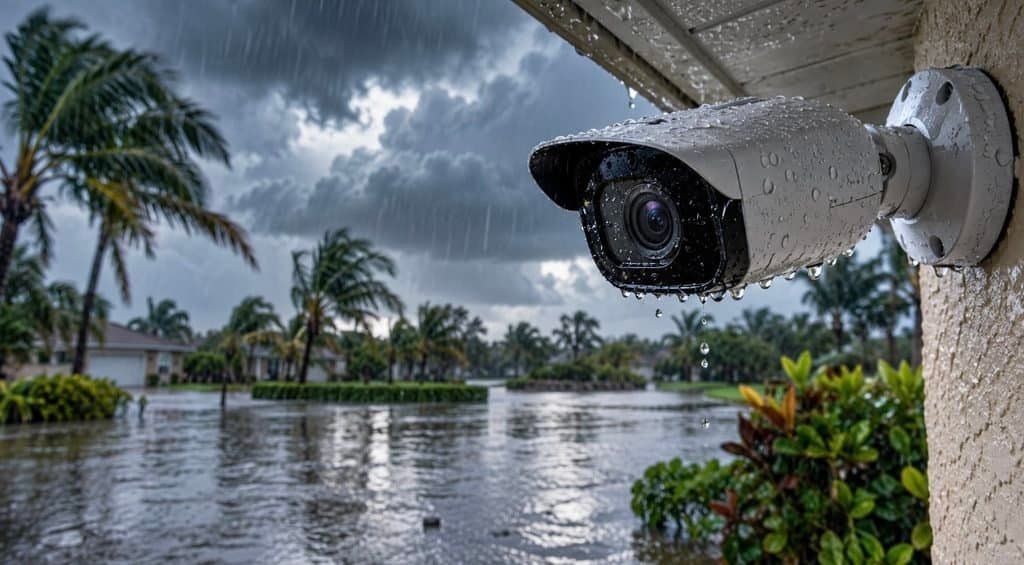
Waterproof Security Cameras in Florida: Why the Installation Matters as Much as the Camera
Florida weather can put outdoor security cameras to the test. But sometimes the camera isn’t the problem — the installation is.
Published September 2026 | By Certified Security Systems
If you live in South Florida, you already know that a “little rain” can turn into several inches of water in a very short period of time.
And when that happens, outdoor security cameras are suddenly dealing with something very different from an ordinary afternoon shower.
Over the past several weeks, heavy rainfall across western Palm Beach County has put outdoor security equipment to the test. In and around the western communities, significant rainfall has contributed to flooding and water intrusion concerns.
That brings up an important question:
Are your outdoor security cameras actually installed to handle Florida weather?
We recently saw exactly why that question matters when we visited a home in Loxahatchee, Florida where an existing camera system had been installed by a handyman.
The customer had high-end security cameras that were still under warranty. The cameras themselves were worth keeping. The problem was the installation.
We rewired the system, properly mounted the cameras, sealed the installation using commercial-grade mounting hardware, and got the customer back up and running.
In this case, the customer was fortunate. Because the cameras were still under warranty, they were able to replace the equipment without having to absorb the full cost of an entirely new camera system.
And because we stand behind our installations, our workmanship is warrantied as well.
In This Article
- A Loxahatchee Security Camera Installation That Went Wrong
- The Camera May Be Waterproof. The Installation May Not Be.
- What Does an IP Rating Mean?
- What to Look for in an Outdoor Security Camera
- Ubiquiti UniFi Outdoor Security Cameras
- Why Professional Installation Matters
- Common Outdoor Camera Installation Problems
- Should You Repair or Replace Your Security Camera System?
- How Certified Security Systems Approaches Camera Upgrades
- Frequently Asked Questions
- Sources & Further Reading
A Loxahatchee Security Camera Installation That Went Wrong
One of the best ways to understand the importance of proper weatherproofing is to look at what can happen when it isn’t done correctly.
We recently went to a home in Loxahatchee where the customer’s outdoor security cameras had been installed by a handyman.
The homeowner had invested in high-end cameras. The equipment itself was not inexpensive, and fortunately, the cameras were still covered by the manufacturer’s warranty.
But the installation presented problems.
Outdoor security cameras don’t simply need to be “put on the wall.” A proper installation has to account for the camera housing, mounting surface, cable routing, connections, water exposure, drainage, and the way the camera is positioned.
In Florida, that matters even more.
Heavy rain can find its way into improperly protected cable connections, mounting points, junctions, and other areas that may not be obvious until the system starts having problems.
In this case, we rewired the system and remounted the cameras using commercial-grade mounting hardware designed to provide a properly sealed installation.
Once everything was corrected, the customer was back up and running.
The best part?
Because the cameras were still under warranty, the homeowner was able to save money by having the equipment replaced under warranty instead of automatically purchasing an entirely new camera system.
That’s an important distinction.
Sometimes the right answer isn’t “replace the entire system.” Sometimes the right answer is figuring out what can be saved, what needs to be replaced, and what needs to be installed correctly.
The Camera May Be Waterproof. The Installation May Not Be.
This is one of the biggest misconceptions we see with outdoor security cameras.
A manufacturer can give a camera a strong IP rating, but that doesn’t mean every part of the installation is automatically protected from water.
Think of the camera as one component of an entire system.
The camera housing may be weather-resistant. But what about:
- The network cable?
- The RJ45 connection?
- The cable entry point?
- The junction box?
- The mounting hardware?
- The cable coming through the wall?
- The orientation of the camera?
- Water running down the wall toward the connection?
A camera can have excellent weather protection and still experience problems if the surrounding installation allows water to reach vulnerable components.
That’s why weatherproof camera installation isn’t simply about buying a camera with a high IP number.
It’s about building the entire installation with Florida weather in mind.
What Does an IP Rating Mean?
When shopping for an outdoor security camera, you’ll often see an IP rating such as IP65, IP66, or IP67.
IP stands for Ingress Protection. The rating describes how well the device is protected against the entry of solids and liquids.
According to Reolink’s official guidance, the second number in an IP rating relates to water protection. For example, IP65 provides protection against low-pressure water jets, IP66 provides protection against powerful water jets, and IP67 adds protection against temporary immersion.
Ubiquiti also publishes IP ratings for its UniFi devices and recommends selecting equipment rated at least IPX4 for outdoor installations. Ubiquiti also emphasizes that proper mounting remains important even when a device has an appropriate IP rating.
In other words:
An IP rating is important. Proper installation is still essential.
For a Florida outdoor camera, we generally want to look at the entire environment rather than simply asking, “Is this camera waterproof?”
What to Look for in an Outdoor Security Camera
There isn’t one security camera that is perfect for every property. The right camera depends on the location, viewing distance, lighting, mounting position, recording requirements, and the type of activity the homeowner or business needs to monitor.
However, there are several characteristics we look for when evaluating outdoor cameras.
1. A Strong Weather-Resistance Rating
For an outdoor Florida installation, weather resistance should be one of the first specifications we examine.
Reolink, for example, offers outdoor cameras with IP65, IP66, and IP67 ratings depending on the model.
The exact rating should always be checked for the specific camera being installed rather than assuming every model from a manufacturer has the same weather protection.
2. PoE When a Wired System Makes Sense
Power over Ethernet, or PoE, allows compatible cameras to receive power and network connectivity through Ethernet cabling.
For many permanent outdoor installations, a properly installed wired PoE camera can provide a clean and dependable connection without relying on Wi-Fi signal strength at the camera.
3. The Right Camera for the Location
A driveway may need a different camera than a front door. A long driveway may benefit from optical zoom. A large commercial property may require a different combination of cameras than a single-family home.
That’s why we don’t believe in simply putting the same camera everywhere.
Ubiquiti UniFi Outdoor Security Cameras
Ubiquiti’s UniFi Protect platform is another option we consider for outdoor surveillance applications.
Current UniFi Protect cameras include outdoor-rated models such as the G6 Turret, G6 Pro Turret, G6 Dome, G6 Pro Dome, G6 Pro 360, and other outdoor-ready cameras.
Ubiquiti publishes the IP and IK ratings for its cameras, making it possible to evaluate water resistance and impact protection based on the specific model.
For example, Ubiquiti lists IP66 weather protection on several of its outdoor dome and turret cameras, along with IK ratings on models designed for increased impact resistance.
But again, the rating is only part of the equation.
Ubiquiti specifically notes that outdoor installation requires appropriate mounting considerations. For example, its guidance recommends placing dome cameras under an overhang to help prevent water from accumulating on the lens.
That’s the kind of detail that matters when you’re installing cameras in an environment where heavy rain is normal.
Why Professional Installation Matters
We aren’t saying every security camera installation requires a professional.
Some homeowners are perfectly comfortable installing their own equipment.
But there is a major difference between mounting a camera and designing and installing a reliable outdoor surveillance system.
A professional installation should consider:
- Camera placement and viewing angle
- Water exposure
- Cable routing
- Sealed cable entry points
- Mounting surfaces
- Commercial-grade mounting hardware where appropriate
- Network and PoE requirements
- Recorder placement
- Nighttime visibility
- Motion detection zones
- Maintenance and future serviceability
The goal isn’t simply to get the camera working today.
The goal is to install a system that continues working when the weather gets ugly.
Common Outdoor Camera Installation Problems
When an outdoor camera system begins having problems after heavy rain, homeowners often assume the camera itself has failed.
Sometimes it has.
Sometimes the problem is somewhere else.
Water in a Cable Connection
A camera may continue working for months before a poorly protected connection begins causing intermittent problems.
Improper Cable Entry
If a cable enters a wall or junction point without appropriate protection, water can potentially travel toward equipment or into the structure.
Incorrect Mounting
Mounting location and orientation can affect how rain reaches the camera, lens, connectors, and mounting hardware.
Exposed Connections
Outdoor-rated equipment still requires attention to the connections surrounding it. A weather-resistant camera doesn’t make an exposed network connection automatically weatherproof.
Improperly Sealed Hardware
Outdoor installations should be evaluated as a complete system. Sealing and protecting the mounting and cable-entry points is just as important as choosing an appropriately rated camera.
Should You Repair or Replace Your Security Camera System?
This is where things get interesting.
At Certified Security Systems, we don’t automatically recommend repairing an existing system.
In some situations, a repair can cost enough that the homeowner would be better served by replacing the system with newer equipment.
That’s why we look at the entire system before deciding what makes sense.
We consider:
- The age of the cameras
- The condition of the wiring
- The recorder
- Camera compatibility
- Available resolution
- Storage requirements
- Network infrastructure
- Whether equipment is still under warranty
- The cost of repairing versus replacing the system
In the Loxahatchee installation we described above, the warranty made a significant difference.
The customer had high-end cameras that were still covered. Instead of automatically selling the homeowner an entirely new system, we were able to work with the existing equipment situation, replace the cameras through the warranty process, correct the wiring, and properly install the system.
That saved the homeowner money.
And that’s exactly why we believe a security assessment should come before making assumptions about what needs to be replaced.
How Certified Security Systems Approaches Outdoor Camera Installations
Our approach is pretty simple:
We want the equipment and the installation to work together.
That means we look at more than the camera specifications.
We look at where the camera is going, how the cable will get there, how the equipment will be mounted, how the connections will be protected, and what the system needs to accomplish.
For outdoor installations, we pay particular attention to water exposure and cable management.
When appropriate, we use commercial-grade mounting solutions and take steps to properly protect the installation from the environment.
And if we’re working on an existing system, we’ll evaluate what can reasonably be reused before recommending replacement.
Sometimes the answer really is a brand-new system.
Sometimes it’s an upgrade.
And sometimes, as the Loxahatchee customer discovered, the best solution is to save the equipment that still has value, replace what needs replacing, and correct the installation.
Our Workmanship Is Warrantied
When you invest in a professional security camera installation, you’re not just paying for someone to mount a camera.
You’re paying for the installation itself to be done correctly.
Certified Security Systems warranties our workmanship because we stand behind the work we perform.
Security Camera Installation in Loxahatchee and Palm Beach County
Certified Security Systems provides residential and commercial security camera installation, upgrades, and system solutions throughout Palm Beach County.
We regularly work with homeowners and businesses in communities including:
- Loxahatchee
- Royal Palm Beach
- Wellington
- West Palm Beach
- Palm Beach Gardens
- Lake Worth
- Boca Raton
- Jupiter
- And surrounding Palm Beach County communities
If your outdoor security cameras stopped working after heavy rain, don’t automatically assume you need an entirely new system.
The problem could be the camera. It could be the wiring. It could be a connection. Or it could be the way the system was originally installed.
Let us take a look before you spend money replacing equipment that may still have value.
Contact Certified Security Systems or call 561-285-2780 to discuss your security camera system.
Frequently Asked Questions About Waterproof Security Cameras
Are security cameras really waterproof?
Some outdoor security cameras are designed to resist significant exposure to rain and water, but the level of protection depends on the camera’s IP rating. The installation itself also needs to protect vulnerable connections, cables, and entry points.
What IP rating should an outdoor security camera have?
There is no single IP rating that is appropriate for every situation. Outdoor cameras commonly use ratings such as IP65, IP66, and IP67. The correct choice depends on the environment and the specific camera. Always check the manufacturer’s specifications for the exact model.
Can heavy rain damage a security camera?
A properly rated and properly installed outdoor camera is designed to withstand its specified environmental conditions. However, improperly protected connections, cable entries, mounting points, or installation practices can create opportunities for water intrusion.
Can a handyman install outdoor security cameras?
A handyman may be able to physically mount a camera, but outdoor security camera installation involves more than attaching the camera to a wall. Proper cable routing, connections, weather protection, network configuration, camera placement, and system testing all matter.
Do you repair security camera systems?
We evaluate existing systems and can determine whether repair, upgrade, replacement, or a combination makes the most sense. We don’t automatically recommend repairing an older system because repair costs can sometimes approach the cost of installing newer equipment.
Can you work with cameras that are still under warranty?
If the equipment is still covered by a manufacturer’s warranty, we can evaluate the installation and help determine what equipment needs to be replaced and what can remain. In our recent Loxahatchee project, the customer’s high-end cameras were still under warranty, allowing the homeowner to replace the affected equipment while we corrected the installation.
Does Certified Security Systems warranty its installation work?
Yes. Certified Security Systems stands behind its workmanship and warranties the work we perform.
The Bottom Line: Weatherproofing Is More Than a Camera Specification
Florida weather doesn’t care how much your security camera cost.
A high-end camera can still have problems if it isn’t installed correctly.
And an older camera system isn’t necessarily something that needs to be thrown away.
The Loxahatchee installation was a perfect example. The customer had expensive cameras, a problematic installation, and a situation that could have turned into a much larger expense.
Because the cameras were still under warranty, the homeowner was able to save money on the equipment. We corrected the wiring, installed the cameras using properly sealed commercial-grade mounts, and got the system working again.
That’s why we believe in evaluating the whole system before recommending a replacement.
When it comes to outdoor security cameras in Florida, the camera matters.
But the installation matters just as much.
Sources & Further Reading
- Reolink: Introduction to Security Camera Weatherproof IP Ratings — Official explanation of IP64, IP65, IP66, and IP67 weather-resistance ratings. Read the Reolink IP Rating Guide
- Ubiquiti: UniFi Device IP and IK Ratings — Official guide explaining IP ratings, outdoor protection, and mounting considerations for UniFi devices. Read the Ubiquiti IP and IK Rating Guide
- Ubiquiti UniFi Physical Security — Official information on current UniFi Protect security camera options and specifications. Explore UniFi Protect Cameras
- Reolink Outdoor Security Cameras — Official outdoor camera lineup and weatherproofing specifications. Explore Reolink Outdoor Cameras
Need Help With Your Outdoor Security Cameras?
If your security cameras stopped working after heavy rain, or you’re concerned that your existing installation wasn’t properly weatherproofed, Certified Security Systems can evaluate the system and help determine what actually needs to be replaced.
Serving Loxahatchee, Royal Palm Beach, Wellington, West Palm Beach, Boca Raton, Jupiter, and communities throughout Palm Beach County.
Contact Certified Security Systems | 561-285-2780