
Why Two Security Cameras Can Tell Two Different Stories About the Same Incident
Two security cameras can record the same person, the same vehicle and the same moment in time, yet reveal entirely different details. The reason often comes down to security camera angles, camera design and what each camera is intended to capture.
At a Palm Beach estate, a 35-camera installation demonstrated why overlapping views and different camera capabilities can make such a difference. Here’s what homeowners and property managers can learn from it.
How Security Camera Angles Change What You See
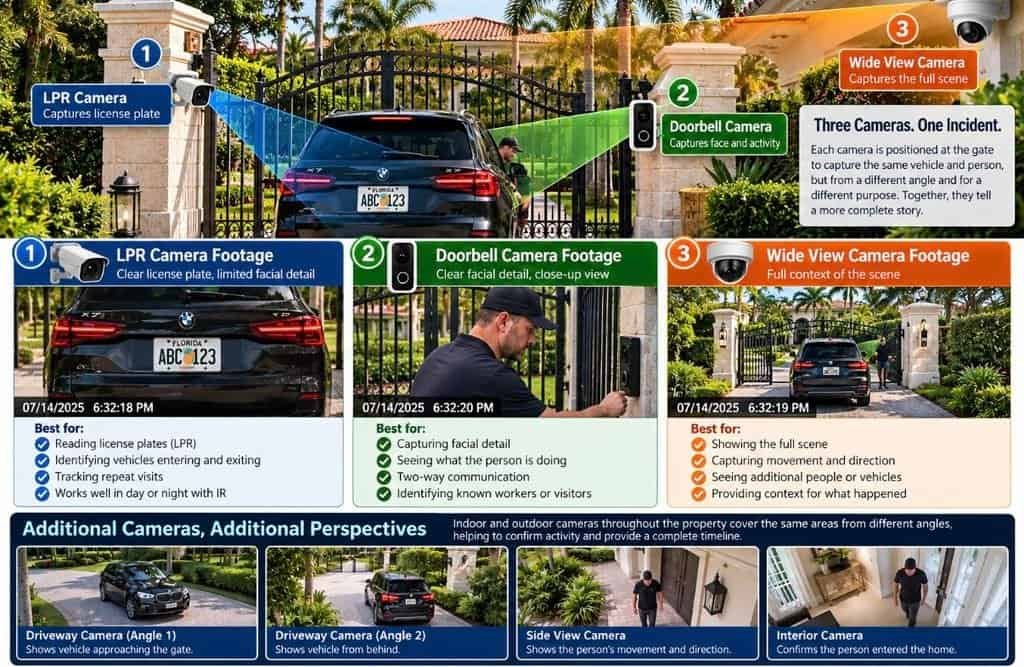
Imagine a vehicle pulling through a gated entrance. One camera captures its license plate. Another captures the person approaching the gate. A third records the vehicle’s movement along the driveway.
All three cameras may be recording the same event, but their footage can look remarkably different. That’s because security camera angles determine perspective, while the camera’s lens, resolution, lighting and settings affect the details it can capture.
A wide-angle camera may show the entire entrance but render a distant face too small to identify. A camera with a narrower field of view may capture more facial detail while missing activity happening just outside its frame.
Three Security Camera Angles, Three Different Purposes
Different cameras can provide complementary views of the same location. The goal isn’t to make every camera do everything. It’s to choose the right camera and security camera angle for the information you need.
1. License Plate Recognition
Designed to capture vehicle identification details
What it can reveal:
- License plate details, when properly configured
- Vehicle entry and exit activity
- Potentially useful vehicle records for later review
LPR performance depends on placement, speed, lighting, plate condition and system configuration.
2. Doorbell Camera
Designed to capture activity at an entrance
What it can reveal:
- A visitor’s face, depending on conditions
- Activity around the gate or entrance
- Interactions and movement near the camera
Its viewing angle and field of view may limit how well it captures vehicles or distant activity.
3. Wide-View Camera
Designed to show more of the surrounding area
What it can reveal:
- The broader scene around an entrance
- Vehicle movement and direction
- People and activity across a larger area
A wider view can provide context, but objects and faces may appear smaller.
When these cameras are positioned thoughtfully, they can complement one another. The LPR camera may help establish which vehicle entered, the doorbell camera may show who was at the gate, and the wide-view camera may help explain what happened around them.
Inside a Palm Beach Estate’s 35-Camera Security Installation
Last year, Certified Security Systems was called to a Palm Beach estate after the property experienced multiple break-ins. The owner suspected that one of the many caretakers or workers who had legitimate access to the property might have been returning after hours.
The challenge wasn’t simply to record the entrance. The owner wanted a better way to document who and what was coming and going, while also monitoring activity throughout the estate.
At the gate, CSS installed a license plate recognition camera and a doorbell camera. Both captured the same people and vehicles, but from different angles and for different purposes.
The LPR camera was intended to capture license plate information. The doorbell camera provided another view of the people and activity at the entrance. Together, they offered complementary information that neither camera was designed to provide entirely on its own.
Beyond the gate, CSS installed 35 indoor and outdoor cameras. Many covered overlapping spaces from different angles. Rather than relying on one view of a hallway, driveway or other area, the system offered multiple perspectives of activity throughout the property.
After the installation, the customer experienced no further reported thefts. Could the visible cameras have deterred potential intruders? It’s certainly possible. However, without knowing exactly why the thefts stopped, we can’t attribute the outcome solely to the cameras.
Why Overlapping Security Camera Angles Matter
Overlapping security camera angles are sometimes viewed as unnecessary duplication. In reality, they can serve an important purpose when planned correctly.
Consider a person walking down a hallway. One camera might capture the person approaching from the front, while another shows the same person from the side. A third might capture the entrance to the hallway.
Each recording can help answer a different question. Where did the person come from? Which direction did they travel? Did they enter a particular room? What happened just before or after they appeared on camera?
The same principle applies outdoors. A driveway camera may show a vehicle approaching, another may capture it leaving, and a side-yard camera may record activity that the driveway cameras cannot see.
How Security Camera Angles Affect Identification
One of the biggest misconceptions about security cameras is that higher resolution automatically guarantees better identification. Resolution matters, but security camera angles and positioning are equally important.
Distance and field of view
A camera mounted too far from a person may record the activity clearly without capturing enough facial detail. A wider field of view can include more of the property but spread the available image detail across a larger scene.
Lighting and shadows
A camera facing directly into bright sunlight, headlights or strong exterior lighting may struggle with important details. Nighttime lighting, infrared performance and the direction of the light source all influence the resulting footage.
Mounting height and angle
A camera mounted too high may capture the top of someone’s head rather than useful facial detail. A camera aimed too low might miss important activity farther away. The right mounting height depends on the camera’s purpose and the area being monitored.
Movement and timing
A moving vehicle presents different challenges from a person standing at a gate. Shutter speed, exposure, frame rate and camera positioning can all affect whether a moving subject is captured clearly.
These factors explain why two cameras with similar megapixel ratings can produce very different results when they are installed at different locations or aimed at different parts of the same scene.
How to Plan Security Camera Angles for Your Property
Whether you’re protecting a home, a large estate or a commercial property, planning security camera angles should begin with the information you need to capture.
-
Identify the critical areas.
List the entrances, driveways, walkways, storage areas and other locations where visibility matters most. -
Determine what each camera needs to capture.
Decide whether the priority is reading a license plate, seeing a face, monitoring movement or documenting a larger scene. -
Choose the right lens and mounting position.
Match the field of view to the intended task. Consider distance, lighting, obstructions and the direction of movement. -
Look for meaningful overlapping coverage.
Use additional views where they can help establish movement, provide context or cover areas that another camera cannot see. -
Test the actual footage.
Review daytime and nighttime recordings. Check whether the cameras capture the details you intended, rather than assuming the specifications alone guarantee a useful result. -
Review the system as the property changes.
New landscaping, parked vehicles, renovations and changing lighting can create obstructions or reduce the effectiveness of existing camera angles.
Frequently Asked Questions About Security Camera Angles
Can two security cameras record the same incident differently?
Yes. Different security camera angles, lenses, mounting heights, lighting conditions and recording settings can produce very different footage of the same event. One camera may capture a license plate clearly, while another captures a person’s face or the wider scene.
Are overlapping security cameras a waste of money?
Not necessarily. Overlapping cameras can provide complementary views, help document movement and reduce reliance on a single camera’s perspective. However, each additional camera should serve a clear purpose.
Is a higher-megapixel camera always better?
No. Higher resolution can provide more image detail, but distance, lens selection, lighting, motion and camera placement also determine whether useful details are visible. The right combination matters more than megapixels alone.
Should I use an LPR camera and a regular security camera together?
They can work well together when vehicle identification and general scene monitoring are both important. An LPR camera is designed to capture license plates, while a conventional camera may provide a wider view or additional detail about the surrounding activity.
Can security cameras actually prevent theft?
Visible security cameras may deter some unwanted activity, but deterrence isn’t guaranteed. Cameras can also help document incidents and provide footage for later investigation. The effectiveness of any system depends on the property, the installation and the circumstances.
The Right Security Camera Angle Can Change What You Know
A security camera system shouldn’t be judged only by how many cameras it has or how many megapixels they offer. What matters is whether the system captures the information a property owner actually needs.
As the Palm Beach estate installation illustrates, different cameras can provide different perspectives of the same event. When those perspectives are planned carefully, they can work together to create a more useful picture of what happened.
For large properties, commercial sites and homes with multiple entry points, professional camera placement can make the difference between simply recording activity and capturing meaningful details.
Explore Certified Security SystemsCertified Security Systems serves homeowners and businesses throughout Palm Beach County, Florida. Camera performance varies with equipment, installation, lighting and environmental conditions.
Security Camera Technical Resources
Want to learn more about how camera lenses, positioning and field of view affect surveillance footage? These technical resources offer additional information from industry and search experts.
Camera Lenses and Field of View
Learn how focal length and lens selection influence what a surveillance camera can see.
Explore the Axis lens guide →License Plate Camera Positioning
Explore the technical considerations for capturing readable license plates, including camera angles, lighting and installation.
Read the license plate capture white paper →Google’s Guidance on Outbound Links
See Google’s recommendations for useful, descriptive links that help readers explore related information.
Read Google’s documentation →