
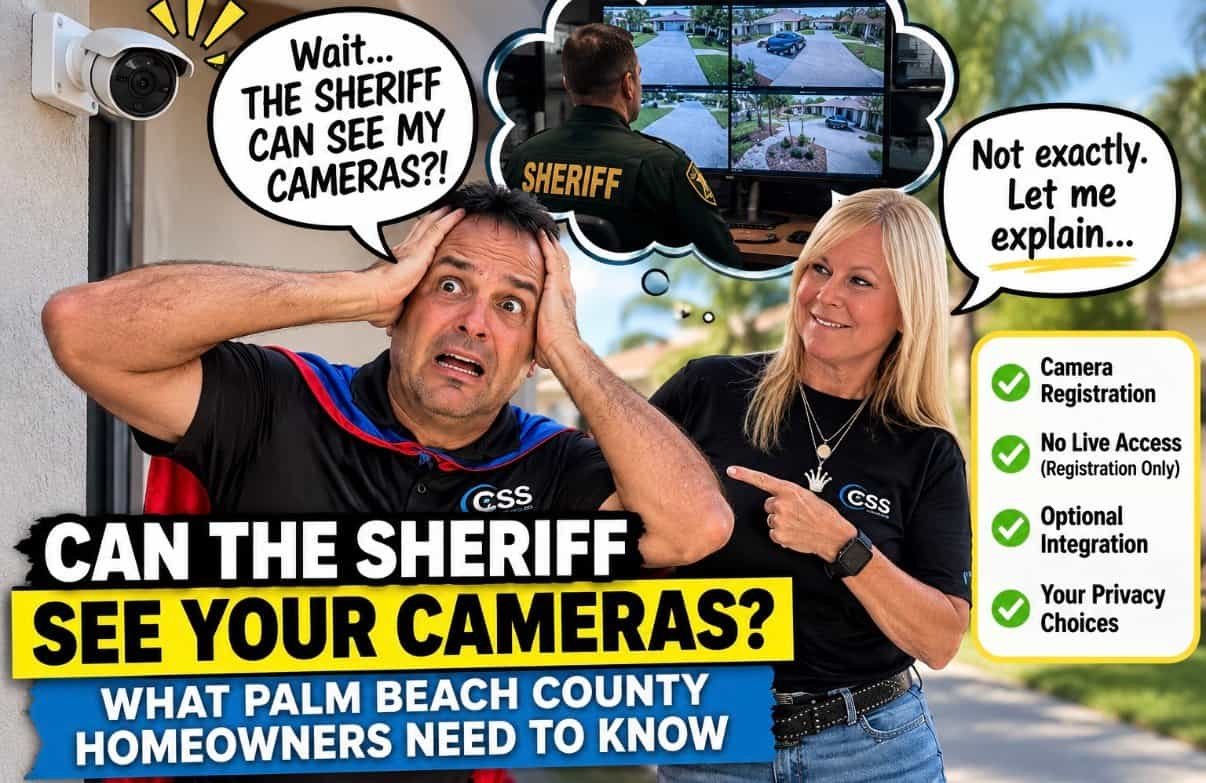
A West Palm Beach homeowner asked us a question recently that stopped us in our tracks: “If the authorities can watch my cameras whenever they want, why am I paying for a security system?”
He didn’t want his CCTV connected to the internet at all. Only local. Recording to a box in his own house, viewed on a monitor in his own house. His thinking was simple: if nothing is online, nobody can look in.
We thought his worry was important enough to write about, because he is far from the only person in Palm Beach County wondering the same thing, especially now that the Palm Beach County camera registry is part of the conversation.
CSS Man: “Wendy, I have registered my cameras with the Sheriff. They can now see everything. My driveway. My backyard. My cape collection.”
Wendy: “Evan, they can’t see anything. Did you read the terms?”
CSS Man: “I read the part that said ‘Register.’ I clicked it with the confidence of a man who can fly.”
Wendy: “You cannot fly. And take the cape off your uniform. Sit down. Let’s read it together.”
What the Palm Beach County camera registry actually says
The Palm Beach County Sheriff’s Office runs a Private Security Camera Registration program for residents and businesses. Here is what its own terms and conditions say:
- No direct access. The terms state that at no time will the Sheriff’s Office have direct access to your camera or camera system.
- They ask; you decide. If necessary, PBSO will contact you directly, using the information you provided, to request video evidence relevant to a criminal investigation.
- You can leave. A registrant can ask PBSO at any time to remove their registration record from the database.
- Confidential. PBSO says it keeps your information confidential and will not disclose it to third parties except as reasonably necessary to fulfill lawful responsibility or in accordance with law enforcement practices.
In plain English: registering puts your camera’s location on the Palm Beach County camera registry, a list investigators can use. It does not hand anyone a live feed, a password, or a login.
Myth: “If I join the Palm Beach County camera registry, the Sheriff can watch my property any time they want.”
Busted: According to PBSO’s own program terms, they will not have direct access to your camera or system. Registration is a way for investigators to know a camera exists nearby so they can ask the owner for footage.
Back to our West Palm Beach homeowner: is “local-only” a smart choice?
Honestly? It’s a legitimate choice, and we set it up for customers who want it. Here’s the part most people don’t know: CCTV works completely without the internet. Recording, playback, and motion detection all happen on your NVR (the recorder) inside your property. The internet only matters when you want to watch from somewhere else, like your phone at work.
Going local-only has real benefits:
- No cloud account, so no company holds a copy of your video on its servers.
- Nobody can reach your cameras remotely, whether that’s a hacker, a data breach, or anyone else.
- Joining the Palm Beach County camera registry doesn’t require your cameras to be online either, because the registry is about location, not connection.
And the honest tradeoffs:
- No live view or alerts on your phone when you’re away.
- Updates to your recorder’s software take more effort, because nothing updates itself.
- If you need footage, someone has to physically export it from the recorder, so you need to know how.
Want a middle ground? Some customers connect only a few cameras for remote viewing, or keep the system local and connect it only when they travel. We’ll tell you what fits, not what’s easiest to sell.
“But can police ever get my footage?”
Here is the general picture. This is educational information, not legal advice, so talk to an attorney about your specific situation.
- If police ask for your footage, sharing it is generally voluntary. Joining the Palm Beach County camera registry means they may contact you, but it doesn’t change that you’re the one who decides.
- To compel footage, law enforcement generally needs legal process such as a warrant or subpoena. A warrant can reach footage stored on your own equipment, not only footage in the cloud.
That last point matters. Local-only means nobody can see your cameras at will, but it isn’t a legal shield. What it does give you is control: your footage stays in your house until you, or a court order, decide otherwise.
Myth: “If my cameras aren’t online, my footage can’t ever be requested.”
Busted: Offline cameras can’t be watched remotely, but the recorder is still your property and can be subject to lawful process like anything else you own. Local-only protects you from casual access, not from the law.
Audio is where Florida law gets stricter
Here’s one that surprises people: Florida is an all-party consent state for recording conversations under Florida Statute 934.03. Video-only recording of areas visible from the street is generally fine, but cameras and doorbells that capture sound near your front door are a different story. Turn the microphone off or post clear signage.
- Check your clock. A video stamped with the wrong date or time is much less useful as evidence. Set your NVR’s time and check it every few months.
- Know your retention. How many days of footage does your recorder keep? If you can’t answer that, find out today.
- Practice exporting a clip. The worst time to learn is right after an incident.
- Going local-only? Make sure remote access features like P2P, UPnP, and port forwarding are turned off on your recorder and router. “Not connected” should actually mean not connected.
- Change the default password. Always. Even if your cameras never touch the internet.
- Aim for faces and entrances. A wide view of your whole yard is nice. A clear shot of the person at your door is evidence.
(CSS Man’s bonus tip: capes and security cameras do not mix. Wind-resistant, perhaps. Flight-capable, no.)
So, should you join the Palm Beach County camera registry?
That’s your call, and a good one to make with the facts in hand. Registering is free, voluntary, and removable, and it can help investigators find footage that solves crimes in your neighborhood. Staying off the list is also completely your right. What matters is that you decide based on how the program actually works, not on a rumor.
Whichever way you lean on the Palm Beach County camera registry, a camera system that’s designed well gives you clear, usable footage when it counts. That means the right placement, the right night vision, and a recorder you know how to use. See how we approach security installation across South Florida or browse our services.
Cloud, local, or somewhere in between?
We’ll design it around what you’re comfortable with. Call or text 561-285-2780 or visit certifiedsecuritysystems.org.
Certified Security Systems • 1127 Royal Palm Beach Blvd #336, Royal Palm Beach, FL 33411
References
Palm Beach County Sheriff’s Office: Private Security Camera Registration
The Florida Senate: Florida Statute 934.03