
Written by the Certified Security Systems Team
Black Snow Security Cameras: Is that even a thing??
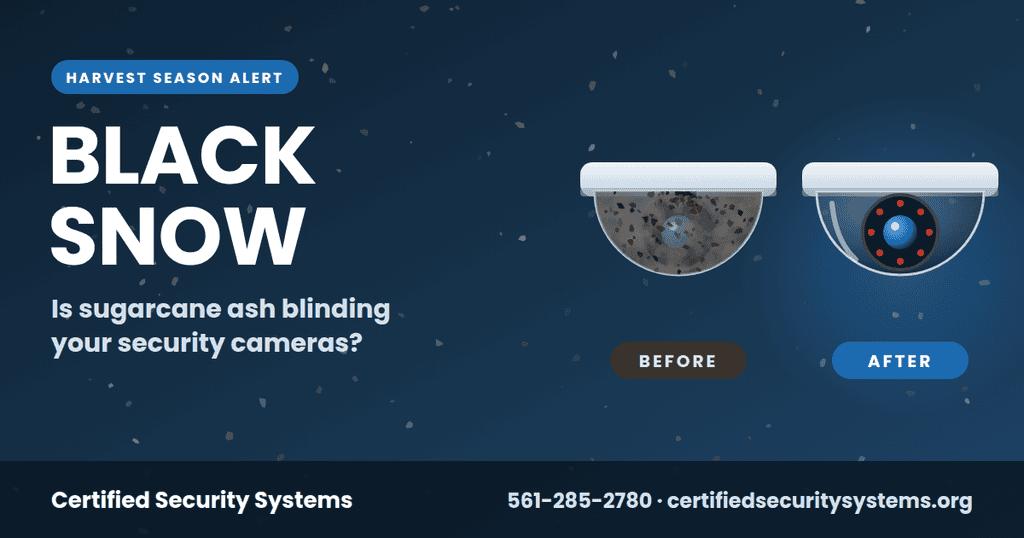
If your security camera footage suddenly looks like it was filmed through a foggy shower door, your camera probably isn’t broken. It may just be covered in sugarcane ash and time for Black Snow Security Cameras.
Every fall, the sugarcane harvest fires up around Lake Okeechobee, and the flakes locals call “black snow” start drifting across western Palm Beach County. Most people think about it on their cars, pool screens and patio furniture. Almost nobody thinks about the cameras bolted under their eaves, the ones that are supposed to be watching the house 24/7.
At Certified Security Systems, we install and service cameras from Royal Palm Beach to Belle Glade, and we see what black snow does to them. Here’s what’s happening, why it matters most at night, and how to keep your cameras seeing clearly all season.
What is “black snow” and when does it fall?
Black snow is the ash left over when sugarcane fields are burned before harvest. Farmers burn off the leafy outer growth so the cane stalks are easier to cut, and the lightweight ash can ride the wind for miles.
Harvest season in the Glades runs roughly from October into spring. The Glades communities closest to the fields, like Belle Glade, Pahokee and South Bay, get the most ash. On days when the wind shifts, flakes can drift east toward Loxahatchee Groves, The Acreage, Wellington and Royal Palm Beach.
We’re not here to debate the burning. We’re here to talk about what that ash does to the equipment protecting your home, because that part nobody else is covering.
What sugarcane ash does to your security cameras;are there Black Snow Specific Security Cameras?
Daytime footage can hide a dirty lens for a long time. Night is where black snow really shows up. Here’s what happens:
- Infrared glare. At night, most cameras switch on built-in infrared (IR) lights to see in the dark. When ash coats the lens or dome, that IR light bounces off the grime and back into the camera. The result is a hazy, washed-out picture, sometimes with a bright white halo in the middle.
- The “foggy night” effect. Fine ash mixed with Florida humidity and morning dew turns into a gritty film. Faces and license plates that should be sharp become blurry shapes.
- Spider magnets. IR lights attract bugs, bugs attract spiders, and ash gives webs something to cling to. A webbed, ash-coated camera is almost useless at night.
- False motion alerts. Drifting flakes and swaying webs can trigger motion detection over and over. After a week of pointless alerts on your phone, most people start ignoring them, and that’s when a real alert gets missed.
Here’s the kicker: the camera itself is usually fine. The problem is what’s sitting on top of it.
A true story from Belle Glade: years of soot, one camera system
A homeowner in Belle Glade called us about his camera system. When our team got up on the ladder, we found years and years of sugarcane soot caked onto his camera lenses. Harvest season after harvest season, the ash had built up layer by layer until his cameras were barely seeing anything.We jokingly asked,”have you considered Black Snow Security Cameras?” Nope
He’d been living with it so long that the blurry picture just seemed normal. That’s the sneaky part about black snow: it doesn’t blind a camera overnight. It dims it a little more every season until you realize you can’t make out a face at your own front door.
We replaced the system with vandal-proof dome cameras and put IP67-rated enclosures throughout the property. The domes give ash a smooth, sealed surface to land on instead of an exposed lens, and the sealed enclosures keep fine dust and moisture from creeping inside where you can’t clean it. Now a quick wipe during harvest season keeps his footage clear. As an added bonus the camera housings are even black which is how we came up with coining the term: “Black Snow Security Cameras” After all we are in Florida
Picking cameras built for ash country
If you live anywhere black snow falls, your camera’s housing matters as much as its resolution. Here’s what we look for:
| Feature | What it means | Why it matters for ash |
|---|---|---|
| IP67 rating | “6” = fully dust-tight; “7” = survives temporary submersion | Fine ash and humidity can’t get inside the housing, where you can’t clean it |
| Vandal-proof dome (look for IK10) | Hardened housing that resists impact | Smooth, sealed surface that’s easy to wipe and tough enough to handle cleaning and storms |
| Hardwired PoE connection | Power and data over one cable | Steady power for IR night vision, with no batteries or Wi-Fi dropouts |
| Smart motion detection | Filters for people and vehicles | Fewer false alerts from drifting flakes and swaying webs |
We install and service Hikvision, Ubiquiti, Reolink and Hanwha systems, and each offers sealed, weather-rated models. The right one depends on where the camera mounts and what it needs to see. That’s where a proper site walk comes in. See our products and our services.
Your harvest-season camera cleaning routine
Think of this as a homework assignment that takes about five minutes per camera.
- Check your night footage first. Pull up a clip after dark on your phone. If it looks hazy or has a white glow, that camera is on the list.
- Blow before you wipe. Use a bulb blower or a can of compressed air to knock off loose ash. Wiping dry ash drags gritty particles across the dome and can leave fine scratches.
- Clear the webs. Sweep away spider webs with a soft brush or duster.
- Wipe gently. Use a clean microfiber cloth, lightly dampened with water or a lens cleaner. Go in one direction, not circles.
- Check again at night. Your next evening clip should look noticeably sharper.
During peak harvest, a monthly check is a smart habit, or right after any day you see flakes on your car.
Don’ts:
- Don’t use paper towels or shop rags. They scratch.
- Don’t use glass cleaners with ammonia. They can cloud plastic domes.
- Don’t pressure-wash your cameras, even rated ones.
- Don’t climb a shaky ladder to reach a second-story camera. Call us instead.
Dirty camera or dying camera? How to tell
If you’ve cleaned the camera and the picture is still bad, the ash may have been hiding a bigger problem. Call a pro if you notice:
- Haze or fog inside the dome or housing (a broken seal lets in moisture and dust)
- A dome that’s yellowed, cloudy or scratched all the way through
- Night vision that doesn’t turn on at all, or flickers
- Footage that keeps cutting out or a camera that drops offline
- Older cameras that were never built to keep outdoor dust out
In those cases, cleaning won’t fix it. A sealed, IP67-rated upgrade usually will.
Frequently asked questions
Does sugarcane ash damage security cameras?
Ash usually doesn’t break a camera, but it coats the lens or dome and ruins the picture, especially at night. On cameras without a proper dust seal, fine ash can work its way inside the housing.
Why is my security camera blurry only at night?
At night, the camera’s infrared lights reflect off dust, ash or spider webs on the lens. That reflection creates haze and glare you don’t see in daylight.
How often should I clean my security cameras in Palm Beach County?
During sugarcane harvest season, roughly October through spring, check your night footage monthly and clean when it looks hazy. The rest of the year, a few times a year is usually enough.
What does IP67 mean on a security camera?
The “6” means the housing is completely dust-tight. The “7” means it can survive temporary submersion in water. For western Palm Beach County, that combination handles ash, humidity and summer storms.
Do you service cameras in Belle Glade and the Glades?
Yes. Certified Security Systems serves Belle Glade, Pahokee, South Bay, Loxahatchee Groves, The Acreage, Wellington, Royal Palm Beach and all of Palm Beach County, plus Martin, Broward and Miami-Dade counties. More answers on our FAQs page.
Can your cameras see through black snow?
Here’s a quick test for tonight: open your camera app after dark and look at the front door. If you can’t read a face, your camera is wearing a sugarcane mustache, and it’s time to do something about it.
Whether you need a cleaning, a sealed upgrade or a whole new system built for ash country, our team handles installs and service from Royal Palm Beach to Belle Glade. And if you already have a written quote from another company, bring it. We’ll beat it, every time.
Call or text 561-285-2780 or visit our contact page to book a free site walk.
Certified Security Systems
1127 Royal Palm Beach Blvd #336, Royal Palm Beach, FL 33411
561-285-2780 | info@certifiedsecuritysystems.org
Sources
- NBC News: In South Florida, “black snow” makes breathing difficult for some residents
- Inside Climate News: Gen Z activists and sugarcane burning
- WLRN: Belle Glade’s falling black snow
Meet the “Black Snow Cameras” (CSS Man’s version)
Black snow cameras are sealed, IP67-rated dome cameras built to keep seeing clearly through sugarcane ash season in western Palm Beach County. CSS Man had his own idea of what that meant. It did not go well.
Real black snow cameras don’t require a cape. Call 561-285-2780.