
5 Home Security Questions Customers Ask | Florida Security Tips
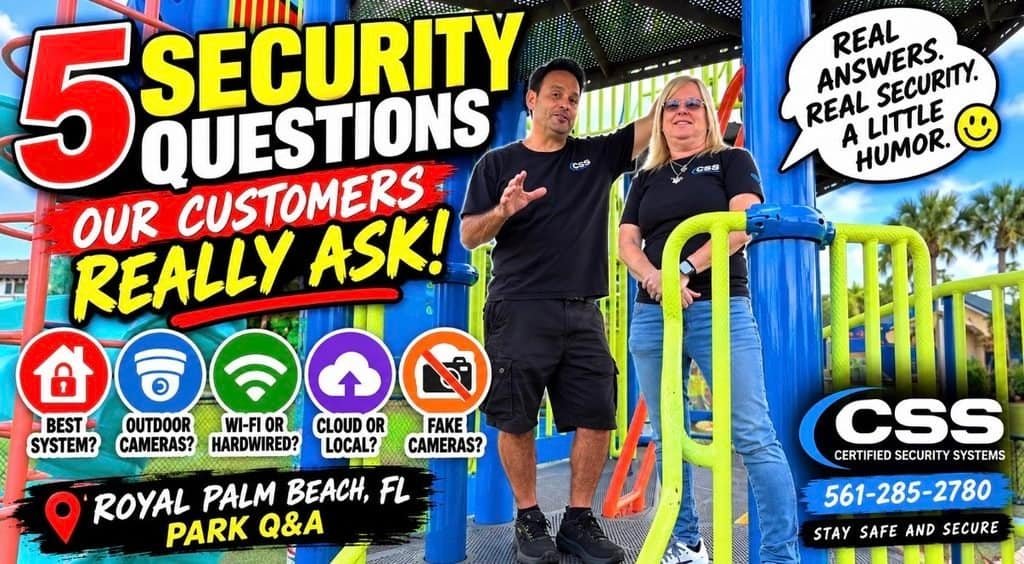
We get a lot of home security questions so we took 5 Home Security Questions YOU asked last week from homeowners, and honestly, some of them deserve a serious technical answer.
Others deserve a Wendy answer.
So we took CSS Man to a local park in Royal Palm Beach, climbed onto a jungle gym, and decided to answer five of the questions our customers ask about home security systems, security cameras, hardwired versus wireless cameras, video storage, and those wonderfully questionable fake cameras.
CSS Man brought the technical knowledge.
Wendy brought the reality check.
Here are five common home security questions, with a little humor along the way.
1. What Is the Absolute Best Home Security System on the Market?
This might be one of the most common home security questions we hear.
The honest answer is that there isn’t one security system that is automatically the best for every home.
A properly designed security system should be based on the property, the home’s layout, the entry points, the homeowner’s concerns, and the level of protection required.
For a higher-security residential installation, a layered approach can combine several technologies, including:
- 4K security cameras
- Glass-break sensors
- Door and window sensors
- Motion detection
- 24/7 professional monitoring
- Smart home automation
- Remote access and notifications
That is what CSS Man was talking about when he described a multi-layered, commercial-grade security ecosystem.
And Wendy’s answer?
“Whichever one is locked when the door-to-door salesman knocks.”
We stand by the technical answer. We also stand by locking your doors.
If you’re comparing different systems for your home, take a look at our home security systems in Royal Palm Beach to see how we approach residential security.
2. What Security Cameras Should We Use for South Florida Outdoor Installations?
Florida is not exactly gentle on outdoor electronics.
Heat, humidity, heavy rain, storms, insects, direct sunlight, and salty air can all create challenges for outdoor security equipment.
For outdoor installations, we typically look for cameras with features such as:
- Weather-resistant construction
- IP-rated protection
- Infrared night vision
- Wide Dynamic Range
- High-resolution video
- Reliable network connectivity
- Active deterrence features when appropriate
For example, outdoor security cameras with an IP67 rating are designed to provide protection against dust and water exposure. Many modern PoE cameras also combine network connectivity and power through a single Ethernet cable.
Outdoor camera specifications vary by manufacturer and model, so homeowners should look beyond simply buying the camera with the biggest megapixel number.
For comparison, Reolink’s outdoor PoE cameras include examples of IP67 weather protection, infrared night vision, and Power over Ethernet connectivity. See the manufacturer’s specifications for the Reolink RLC-810A.
And Wendy’s recommendation?
“The ones that don’t melt in July.”
Honestly, that’s a pretty important Florida specification.
Our Palm Beach County security camera installation service focuses on designing camera coverage around the property instead of simply putting cameras wherever they are easiest to mount.
3. Should I Get Wireless Wi-Fi Cameras or Hardwired CCTV?
This is another question we hear constantly.
There isn’t a single answer for every property, but for many professional surveillance installations, we prefer hardwired PoE security cameras.
Power over Ethernet allows a single network cable to carry both power and data to compatible cameras.
That can provide a reliable connection without depending entirely on the home’s Wi-Fi signal.
Wireless cameras can certainly be useful in the right application. They can make sense where running cable is impractical or where a homeowner specifically wants a wireless solution.
But when we’re designing a permanent surveillance system and the property allows for proper cable runs, hardwired CCTV is often the direction we prefer.
Why?
- Reliable network connectivity
- Consistent power to the camera
- No dependence on Wi-Fi signal strength at the camera
- Excellent option for continuous recording
- Clean integration with an NVR
- Scalable for multi-camera installations
Our security camera and CCTV services include both wired and wireless solutions depending on the property and application.
Wendy’s version is a little simpler:
“Unless you like your camera going offline every time someone streams a movie. Go wired.”
CSS Man may use more technical words. Wendy gets to the point.
4. Do I Need Cloud Storage or Is Local Storage Enough?
This is an important question because your cameras are only as useful as your ability to access the footage when you need it.
Many surveillance systems use an NVR or other local recording device to store video. Local storage can provide continuous recording without requiring every minute of footage to be uploaded to the cloud.
But there is an important consideration.
What happens to your footage if something happens to the recorder?
If someone steals or destroys the NVR, footage stored exclusively on that recorder could be lost.
That is why some security systems use a combination of local recording and off-site or cloud storage.
A redundant approach can provide another layer of protection for important video evidence.
The Cybersecurity and Infrastructure Security Agency also recommends backing up important data to a secure external location or properly vetted cloud service because physical devices can be lost, stolen, damaged, or fail. CISA’s guidance on protecting stored data explains the importance of secure backups.
And Wendy’s expert assessment?
“Or worse… your cat deletes the hard drive. Get the cloud.”
We’re still investigating the cat.
5. Can I Save Money by Installing Fake Dummy Security Cameras?
Technically, you can put a plastic camera on your house.
But a dummy camera doesn’t record video.
It doesn’t provide motion alerts.
It doesn’t give you evidence after an incident.
And it doesn’t provide the capabilities of a functioning surveillance system.
For homeowners who actually want video surveillance, a working security camera system provides substantially more value because it can record activity and allow authorized users to review footage.
Modern systems can also provide features such as:
- Motion detection
- Person and vehicle detection
- Remote viewing
- Mobile alerts
- Night vision
- Continuous recording
- Video playback
- Cloud or local storage
So yes, CSS Man was technically correct when he called dummy cameras “preposterous.”
Wendy’s assessment was slightly more concerning:
“And the local raccoons will immediately use them as a toilet.”
We have not independently verified this scientific claim.
CSS Myths & Tips
CSS Myth: The most expensive security system is automatically the best security system.
CSS Tip: The best security system is the one properly designed for the property. A good system combines the right equipment, correct camera placement, reliable connectivity, appropriate storage, and protection layers that match the homeowner’s actual needs.
Security is not about buying the biggest equipment package. It’s about covering the vulnerabilities that matter.
What Makes a Good Home Security System?
After answering thousands of questions from homeowners, we’ve learned that the most important part of a security system isn’t always the equipment itself.
It’s how everything works together.
A well-designed residential security system can combine alarms, surveillance cameras, smart automation, professional monitoring, and reliable recording into one layered approach.
Smart home technologies such as Z-Wave can also allow compatible devices such as locks, lights, sensors, and thermostats to communicate within an integrated smart home environment. The Z-Wave Alliance explains how Z-Wave technology is used in smart home and security applications.
The goal isn’t to make your house look like a military installation.
The goal is to make it harder to break into, easier to monitor, and easier to respond when something happens.
Why Professional Security System Design Matters
Every home is different.
One property may need a few strategically placed cameras and an alarm system. Another may require multiple 4K cameras, an NVR, perimeter coverage, glass-break detection, smart locks, automation, and professional monitoring.
That is why we don’t believe in blindly selling the same package to every customer.
At Certified Security Systems, we design and install residential and commercial security systems throughout Palm Beach County, including Royal Palm Beach, Wellington, West Palm Beach, Palm Beach Gardens, Jupiter, Boca Raton, Loxahatchee, Westlake, and surrounding communities.
Our services include security cameras, CCTV systems, alarm systems, professional monitoring, smart home automation, access control, and customized surveillance solutions.
You can contact Certified Security Systems to schedule a consultation and discuss what makes sense for your property.
Have More Home Security Questions?
These five questions are just the beginning.
Do you want to know how many cameras your house actually needs?
Wondering where cameras should be placed?
Trying to decide between cloud storage and an NVR?
Not sure whether your Wi-Fi is strong enough for your cameras?
Those are exactly the kinds of questions we want to hear.
Drop your home security question in the comments on our video.
We may answer it in our next CSS Man and Wendy Q&A.
Stay Safe and Secure
We can give you the technical answer.
We can give you the practical answer.
And, occasionally, Wendy can give you the answer that involves raccoons.
Either way, the goal is the same:
See more. Know more. Protect better.
For professional security camera installation, alarm systems, CCTV, and security solutions in Palm Beach County, call 561-285-2780 or contact Certified Security Systems.

🎥 We get asked these 5 questions on almost every job — so we sat down at Crestwood Park North in Royal Palm Beach and answered them on camera. #3 surprises most homeowners. Watch our video here and see if you already know the answers 👀